How did Europe become the richest part of the world? | Aeon Essays
In a time of great powers and empires, just one region of the world experienced extraordinary economic growth. How?
Sam's Personal Website
Joel Mokyr is one of the most important historians on the Industrial Revolution — the period when, through aggressive industrial expansion, Europe became the wealthiest (and, let's face it, probably most violent) region of the world.
I studied Mokyr in university (investigating the question: why did the Netherlands miss out on the Industrial Revolution?). Since I've been diving back into economic history recently, he's been sitting at the top of my reading list. Then I re-discovered this essay by him, which I read a year or two ago and then forgot about. Here, Mokyr summarizes the main points of his research.
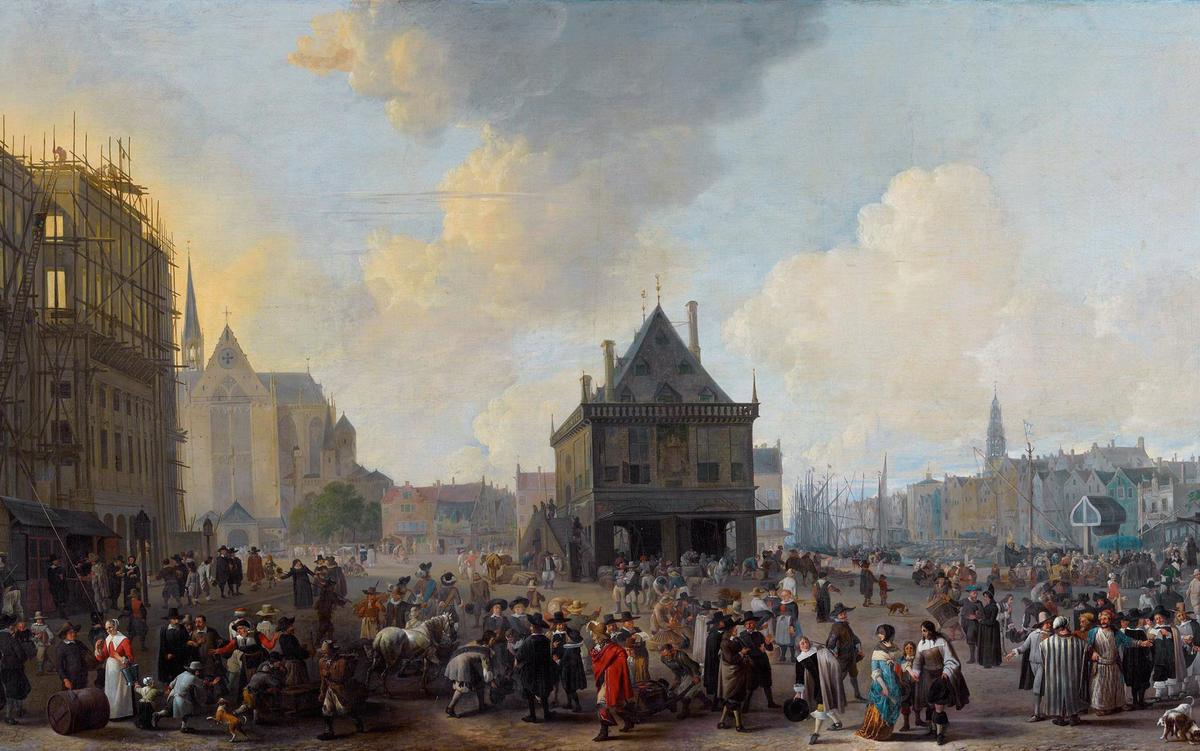
In the second millennium, Europe emerged as an extremely diverse region, with long, twisting coastlines drawing peninsulas divided by rivers and mountains. As wealth grew in Europe, so too did a cosmopolitan culture of knowledge exchange. Religious and political leaders failed to censor intellectual and cultural advancements because the great thinkers could simply publish in or move to another country, like when Galileo's banned books were smuggled out of Catholic Italy and published in Protestant Northern Europe.
Mokyr paints a picture of Early Modern Europe as a colorful tapestry of arts and scholarship. As true as that may be, I suspect that Mokyr glosses over the real engine of European enrichment. Mokyr writes:
In 18th-century Europe, the interplay between pure science and the work of engineers and mechanics became progressively stronger. This interaction of propositional knowledge (knowledge of ‘what’) and prescriptive knowledge (knowledge of ‘how’) constituted a positive feedback or autocatalytic model. In such systems, once the process gets underway, it can become self-propelled. In that sense, knowledge-based growth is one of the most persistent of all historical phenomena – though the conditions of its persistence are complex and require above all a competitive and open market for ideas.
Romantic views of the past focus on the what: Galileo and Newton investigating the forces of the universe. But the real power for the advancement of knowledge came from the how: how to weave cloth more quickly, how to get coal out of the mines more easily, how to sustain a growing workforce more frugally, how to move trips more rapidly. These military and industrial advancements in the how provided the incentive for studying the what. But it's ridiculous to say that the system is self-propelling. I think Mokyr betrays this in the phrase "open market for ideas." A market implies buyers and sellers. If academics and scientists are the sellers, then who are the buyers? More importantly, where does their money come from? Obviously, farmers, miners, and housewives weren't going to the store to buy a fresh treatise on the movement of celestial bodies. Knowledge-based growth depends on colonial and military appropriation to fund the universities, monasteries, and societies that produce knowledge.
Mokyr acknowledges this in his essay:
The idea of knowledge-driven economic progress as the primum movens of the Industrial Revolution and early economic growth is still controversial, and rightly so. Examples of purely science-driven inventions in the 18th century are few.
Europe had gone through many centuries of economic transformation before technological innovation became part of the equation. So, Mokyr is acknowledging that his thesis ignores the fundamental factors in European enrichment — the causes of Europe's economic transformation from the end of the first millennium until late in the second millennium (almost a thousand years of economic transition!).
I appreciate that Mokyr asserts that Europe's "Great Enrichment" was "in no way inevitable." In doing so, Mokyr makes an effort to buck European exceptionalism (the idea that Europeans are essentially more intelligent or civilized) and capitalist realism (the idea that capitalism is an inevitable outcome of history). But, I feel like Mokyr's analysis lacks a critical investigation of the environmental and economic forces that drove industrialization — the Medieval development of a market for land, the immiseration of a proletarian class, the development of centralized nation–states. These are some of the ingredients I've been reading about in Debt, The Origin of Capitalism, and The Great Transition.